Choosing a transport
A transport is the road between a game client and Citadel. All three roads carry the same Citadel message envelope. They differ in which platforms can use them and whether they offer a fast, loss-tolerant lane.
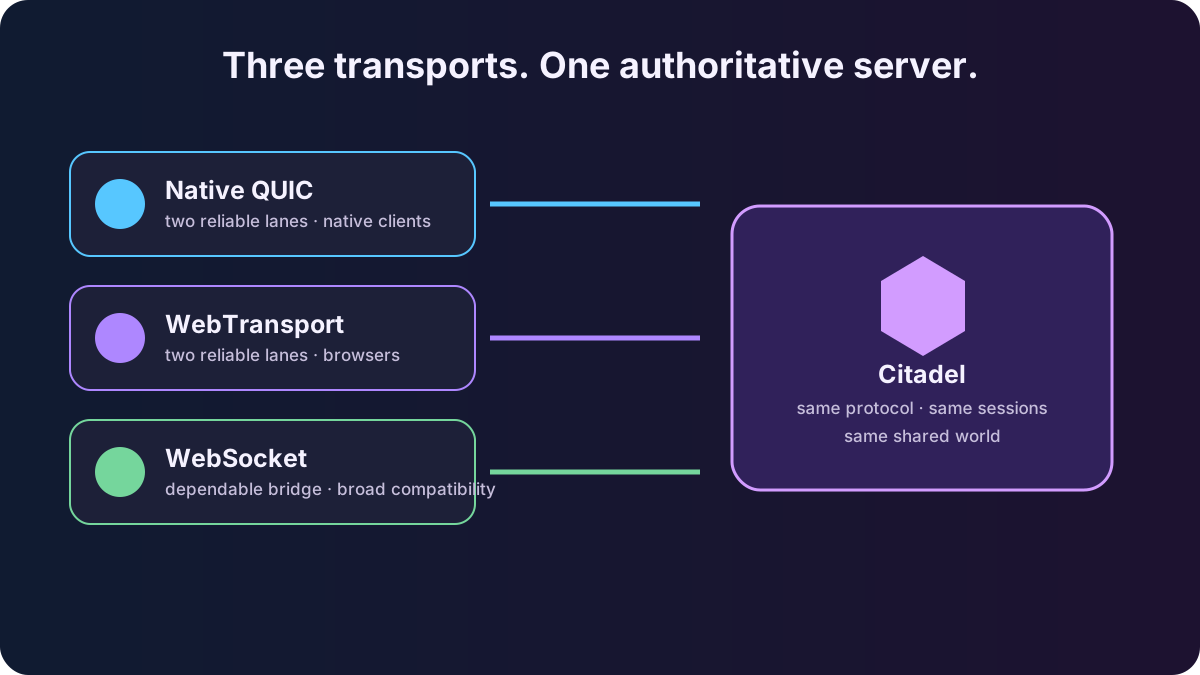
Three couriers, one destination: choose the road that fits the client and the kind of message you need to deliver.
What you need to know
Section titled “What you need to know”- Use QUIC for a native action game that needs fast state updates.
- Use WebTransport when a Chromium browser needs a similar fast lane.
- Use WebSocket for the broadest browser reach and reliable-only traffic.
Citadel deliberately does not ship a hand-rolled RUDP path: QUIC provides the reliable streams, unreliable datagrams, congestion control, and TLS that a native action game needs. The three routes below are the documented newcomer choices exposed by the current engine and web integration guides.
| Your client | Start with | Why |
|---|---|---|
| Unity, Unreal, Godot, or native Rust action game | QUIC | Reliable commands plus unreliable, latest-wins state |
| Chromium browser that needs datagrams | WebTransport | QUIC-like delivery through the browser’s HTTP/3 stack |
| General browser, Node app, or UDP-blocked network | WebSocket | Simple and widely reachable; every message is reliable |
Reliable and unreliable are different tools
Section titled “Reliable and unreliable are different tools”Reliable delivery keeps messages ordered and retries missing data. Use it for actions that must arrive: authentication, room joins, RPCs, purchases, inventory changes, or chat.
Unreliable delivery may lose an update. That is useful for rapidly changing state such as position snapshots. If snapshot 41 is lost but snapshot 42 arrives milliseconds later, waiting for 41 would only make the game feel older.
Fast state and reliable commands usually travel together. QUIC and WebTransport offer both lanes; WebSocket offers the reliable lane only.
QUIC: the native speedster
Section titled “QUIC: the native speedster”Citadel’s native QUIC path uses quinn and TLS 1.3. It sends loss-tolerant game
state as datagrams and reliable control messages as streams. The transport
negotiates the Citadel protocol name citadel/0 during connection setup.
QUIC also handles packet protection, address validation, replay defense, and network-path changes. Citadel still performs its own application handshake after QUIC connects, because an encrypted socket is not the same thing as an authenticated player.
WebTransport: the browser speedster
Section titled “WebTransport: the browser speedster”WebTransport gives Chromium browsers datagrams and reliable streams over HTTP/3. It runs on its own UDP endpoint, separate from native QUIC.
Local development uses a short-lived self-signed certificate that the browser pins by SHA-256 hash. The server prints that hash at startup. Production certificate provisioning remains an operator responsibility.
WebSocket: the dependable all-rounder
Section titled “WebSocket: the dependable all-rounder”WebSocket carries reliable, ordered binary messages and works in the broadest set of browser/network environments. It has no unreliable datagram lane, so it is excellent for commands, social features, RPCs, and prototypes; high-rate native transform snapshots should use QUIC.
Citadel currently serves plain ws:// directly. Terminate production TLS at a
fronting proxy when you need wss://.
When a client cannot keep up
Section titled “When a client cannot keep up”Every connection has a bounded outgoing queue, configured in envelopes. Citadel never blocks gameplay routing on a slow socket: if that queue is full or closed, the current outbound attempt is dropped. Treat transient realtime updates as replaceable, repair them with a fresh authoritative snapshot, and keep durable game facts in storage or a domain service.
Go deeper only when you need it
Section titled “Go deeper only when you need it”- Gateway, rooms & relay explains where messages go.
- Messages & envelopes explains what every transport carries.
- Configuration lists exact endpoints and keys.
- Protocol reference gives byte-level contracts.