Game logic & server authority
Server authority means the client may request an action, but the server has the final word. A player can ask to swing a sword. Your server script checks the range, cooldown, permissions, and current monster HP before it changes the shared world.
That is Citadel’s central game-logic model — the rules you write are GameScript. This page is the deeper mental model behind it.
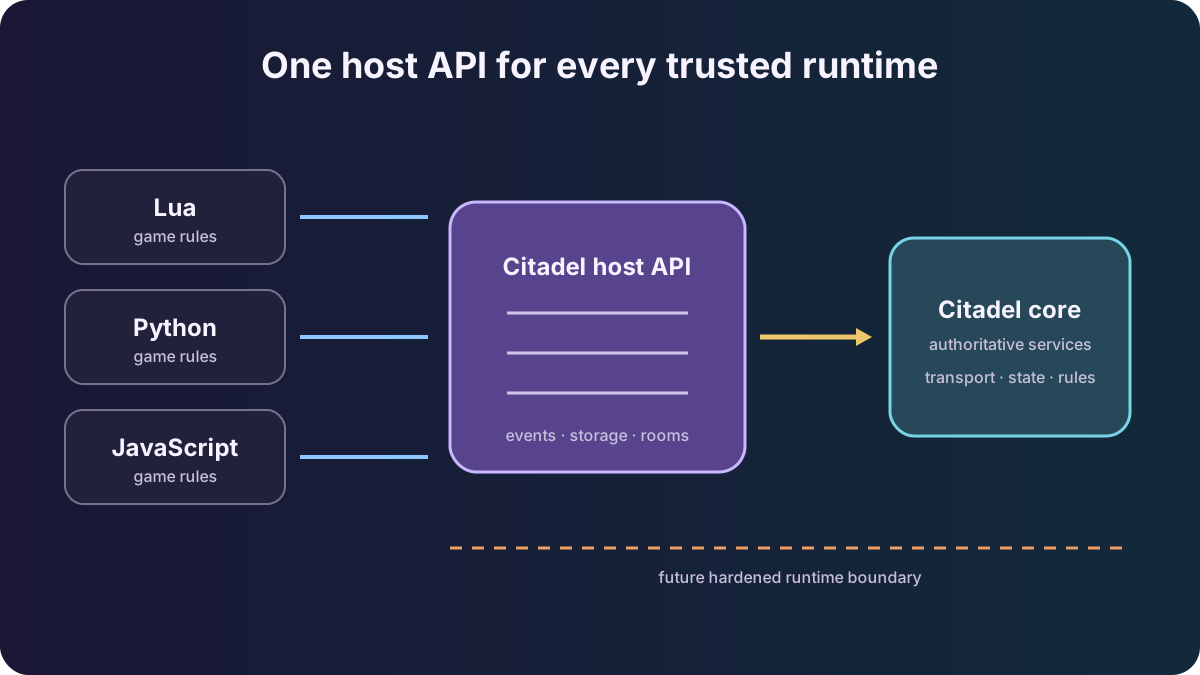
Different languages, one guild contract. Scoped parity gaps are documented below; the hardened WASM tier remains a future quest.
The rulebook lives beside the server
Section titled “The rulebook lives beside the server”Put a selected entrypoint in game/:
| Language | Entrypoint | Availability | Important limit |
|---|---|---|---|
| Lua | main.lua |
Shipped in the default build | Narrow standard library by default |
| Python | main.py |
Build with runtime-python |
Trusted CPython; package its runtime and dependencies |
| JavaScript | main.js |
Build with runtime-js |
Capped QuickJS; no Node, npm, workers, or TypeScript |
Citadel loads the selected runtime inside the node and calls registered handlers when something happens. Runtime language selection can be explicit in config or autodetected Lua-first from the entrypoint.
Hooks hear what happened
Section titled “Hooks hear what happened”The common runtime model includes these core ideas:
on_message— a client sent a game envelope;on_rpc— a caller expects one correlated reply;on_join/on_leave— a realtime participant arrived or left;on_tick— advance server-owned simulation on a schedule.
before_realtime / after_realtime can veto an eligible post-handshake
envelope before routing, then observe its synchronous delivery outcome.
Interceptors never see handshake credentials or reserved authentication frames.
The before hook can only continue or veto; it cannot rewrite the envelope. The
after hook is observer-only, so any outbound commands it attempts are discarded.
Both hooks may log but cannot use domain, storage, or outbound HTTP APIs.
Lua, Python, and JavaScript all expose the room-lifecycle hooks
on_room_create and on_room_join. Use the language-specific reference for
their idiomatic argument and return shapes before designing room admission.
The exact name, argument shape, return value, and language caveats live in the Lua, Python, and JavaScript reference pages.
Authoritative gameplay: the input bridge
Section titled “Authoritative gameplay: the input bridge”Hooks like on_message cover the custom game envelopes you invent. Protected
gameplay — transform-sync input, owner state, script-marked replicated
variables, and avatar spawns — takes a stronger path. In an authoritative match
(a node with runtime.require_script = true whose room is bound to a loaded
script), each of those client actions is decoded and ownership-verified by Rust,
then delivered to your citadel.on_input handler as a normalized event. Your
script answers accept, reject, or correct, and only then does Citadel
change state or replicate to peers. Nothing protected changes before your script
decides, and the answer is fenced and applied all-or-nothing.
See Authoritative gameplay bridge
for the event shapes, the fire/hit rewind_query host API, and the fencing rules.
When require_script = false (the default), there is no bridge: the built-in relay
applies owner state directly for fast prototyping. Choose authority when it counts.
Actions change the world
Section titled “Actions change the world”Handlers can broadcast or send messages, log, spawn/move/despawn replicated actors, use versioned storage, and reach shipped game services. The general shape stays the same in every language:
- receive a trusted context plus untrusted player input;
- validate the request against server-owned state;
- change authoritative state or durable data;
- send the accepted result to the right participant or room.
Citadel mechanically compares declared host-API names across Lua, Python, and JavaScript. That catches name drift; it does not imply that every scoped runtime behavior is complete. Packaging, room coverage, standard libraries, value types, and deadline mechanisms still differ.
Rooms are authoritative match boundaries
Section titled “Rooms are authoritative match boundaries”Named rooms provide the current single-node match/presence boundary. Message
contexts include room_id when traffic belongs to a room, and room broadcasts
stay inside that audience. All shipped runtimes can keep world state by room
and reject a join before the player enters.
Cross-node authoritative match ownership and failover remain planned. Do not store the only copy of durable progression in an in-memory room table.
Transform snapshots stay in their authoritative room
Section titled “Transform snapshots stay in their authoritative room”Transform snapshots are scoped to the recipient’s current room. Server-owned objects carry their authoritative-room binding; client-owned objects derive their scope from their owner’s current room. Before enqueueing a snapshot, Citadel rechecks both the recipient membership and every captured source binding, so a concurrent room transition cannot deliver stale cross-room state. Multiple authoritative rooms may therefore run on one node without exchanging transform state through snapshots.
Server physics is optional
Section titled “Server physics is optional”Replicated actors can opt into deterministic kinematic physics against a cooked room map. Game logic can attach a body, apply an impulse, set movement intent, and inspect grounded state. The fixed simulation updates server-owned transforms and the normal snapshot path sends the result to clients.
Worlds without physics bodies do no physics work. Follow Server-simulated physics bots for the complete training arc.
What happens when a script fails
Section titled “What happens when a script fails”- Per-call budgets: hooks run with a configurable deadline (100 ms by default). Lua, Python, and QuickJS use different interruption mechanisms.
- Caught handler errors: a normal script error or timeout is logged and that invocation is discarded instead of wedging the shared runtime.
- Failure-safe hot reload: in development, a valid edit replaces the runtime; an invalid edit leaves the previous working script active.
- Trusted code still means trusted: native Python extensions or other code outside an interpreter’s safe interruption path can exceed the normal isolation guarantee. Do not describe trusted in-process code as a security sandbox.
Runtime tiers
Section titled “Runtime tiers”Citadel separates two deployment goals.
Trusted tier
Section titled “Trusted tier”For a server operator running code they own. Python is the shipped full-power trusted runtime. Lua remains narrow by default, and shipped JavaScript is capped QuickJS rather than the future full Node ecosystem.
Hardened tier (planned)
Section titled “Hardened tier (planned)”For multi-tenant hosts or third-party code. The design uses WASM plus explicit capabilities, accepting less language power in exchange for a stronger boundary.
Native Rust dynamic libraries are deliberately rejected: Rust has no stable plugin ABI, and an in-process native plugin would undermine crash isolation. The sanctioned future Rust paths are “Citadel as a crate” and Rust compiled to WASM.
What is planned, not shipped
Section titled “What is planned, not shipped”- hardened WASM loading and capability gating;
- supervised Node for full JavaScript/TypeScript with npm and threads;
- Rust-as-a-crate game logic;
- Rust-to-WASM game logic;
- TypeScript transpilation in capped QuickJS mode.
Your next quest
Section titled “Your next quest”- Build a complete rule loop in Knights vs Monsters.
- Compare exact functions in the server SDK reference.
- Add indexed persistence with Storage indexes.